

Improving ad rank is one of the main ways that a business can decrease their customer acquisition cost and become more profitable.
Top ranked ad gets the highest click through rate which directly impacts the CPC or the cost per click of search terms.
That leads to lower spending and higher return on ads spent compared to other advertisers who are competing to appear on the same search term.
Which means you are spending less money than other advertisers for the same search terms, ultimately lowering your overall ads spent.
Furthermore, studies suggest that top ranked ads get most of the clicks and conversions than lower ranked ads and sometimes even more than organic results.
That’s why, we researched more than 20 Google search ads of law firms and here are the top 10 points we have found about ad rank.
Without further ado, let’s jump right in.
Key Findings :
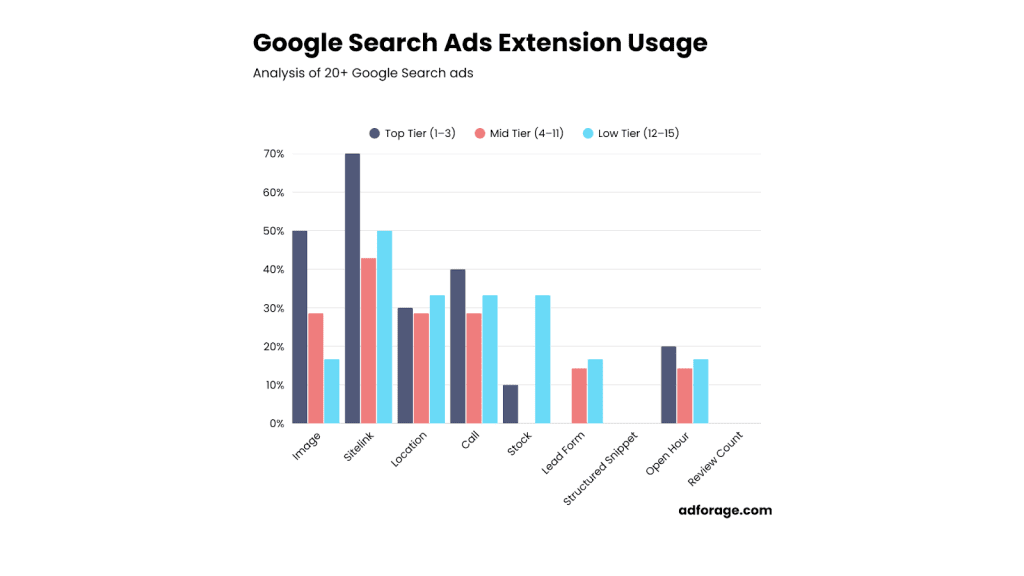
- 50% of top ranked ads use image extension in their search ads.
- Sitelink extension is the most used extension by top ranked ads.
- 40% of top ranked ads use call extensions in their ads.
- Only 20% of top ranked ads use open hour extensions.
- 40% of top ranked ads use CTA and USP in their ads headline.
- 100% of top and mid ranked ads have well directed landing page URLs.
- 60% of top ranked ads have USP and CTA in their description.
- Almost 50% of top ranked ads contained search terms in their ads copy.
- Mid ranked ads contain the most headline word count.
- Top ranked ads copy contain the least number of characters in their ad description.
| Point | Category | Finding | Top Ad Usage |
| 1 | Extensions | Use of Image Extension | 50% |
| 2 | Extensions | Use of Sitelink Extension | 70% (in top 3 positions) |
| 3 | Extensions | Use of Call Extension | 40% |
| 4 | Extensions | Use of Open Hour Extension | 20% |
| 5 | Creative | CTA & USP in Headline | 40% |
| 6 | Technical | Well-Directed Landing Page URL | 100% |
| 7 | Creative | USP & CTA in Description | 60% |
| 8 | Creative | Search Terms in Ad Copy | 50% |
| 9 | Creative | Headline Word Count | Highest in Mid-Ranked Ads |
| 10 | Creative | Description Character Count | Lowest in Top-Ranked Ads |
Google Search Ads Extension Usage
| Extension | Top Ad Usage | Key Benefit & Strategic Insight |
| Image Extension | 50% | Grabs instant attention in text-heavy SERPs. Correlates with top 2 positions, indicating higher CTR and better Quality Score. |
| Sitelink Extension | 70% (Top 3) | Acquires more search real estate and offers users multiple pathways, improving CTR and Quality Score. (Only 42.9% usage in positions 4-10). |
| Call Extension | 40% | Reduces friction for high-intent searchers. Critical for services needing immediate contact (e.g., legal consultation). Converts searches into calls directly from SERP. |
| Open Hour Extension | 20% | Manages expectations and filters lead quality. Best for firms with strict office hours.Underutilized as many prioritize 24/7 lead Capture. |
50% of top ranked ads use image extension in their google search ads
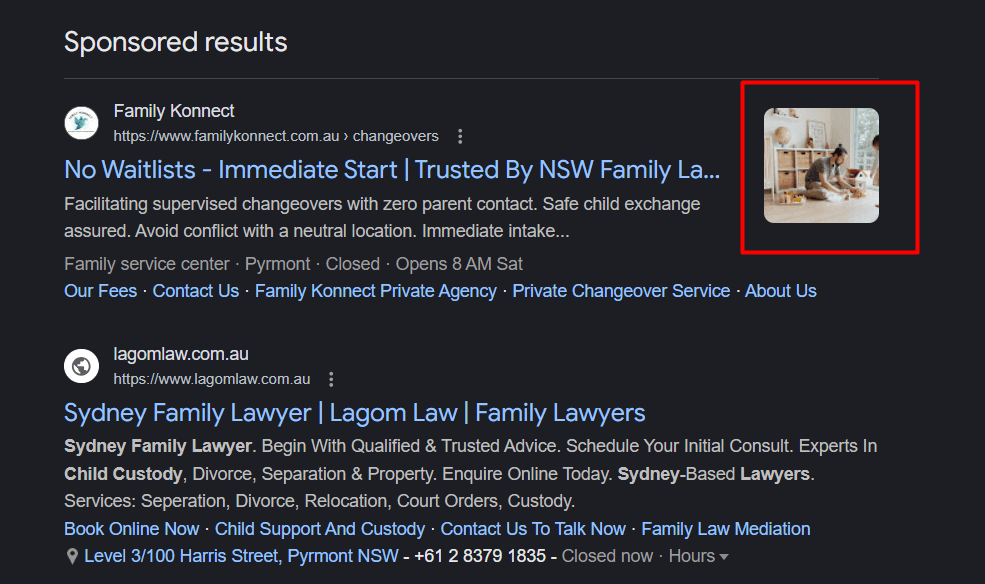
Images in text heavy ads like search ads instantly grabs attention from searchers. But, surprisingly 50% law firms are not using image extension in their google search campaigns. Search ads with images are showing in top 2 positions most of the time, which indicates they are getting higher click through rate improving the quality score of the ads and ultimately decreasing their cost per click and customer acquisition cost compared to those advertisers who are not using image extension in their search campaigns for the search terms.
70% of search ads that ranked in the top 3 positions use Sitelink extension .
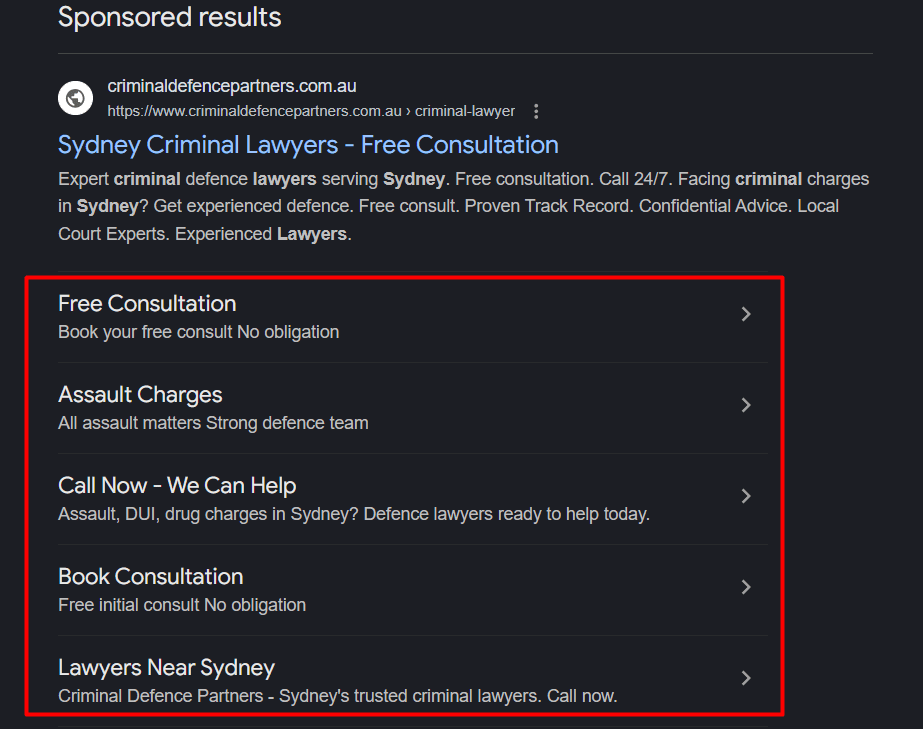
Only 42.9% of the search ads that appeared from 4th to 10th position use sitelink extension.Using sitelink extension helps a search ad to acquire more real estate in the search results. Besides, it gives searchers multiple options to choose which page they want to visit. That’s why it improves the click through rate and the quality score of the ads.
40% of top ranked ads use call extensions in their ads.
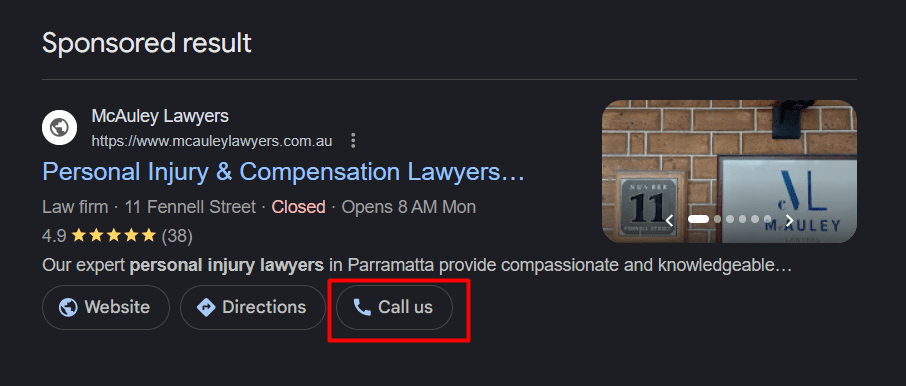
For legal services, where immediate consultation can win a case, making direct contact effortless is crucial. Call extensions place a clickable phone number directly in your ad, reducing friction for high-intent searchers. The fact that 40% of top-ranked ads use this tool highlights its role in converting searches into conversations, directly from the SERP.
Key takeaway:Don’t make potential clients hunt for your number. A call extension is a direct line to new business and a strong trust signal.
Only 20% of top ranked ads use open hour extensions.
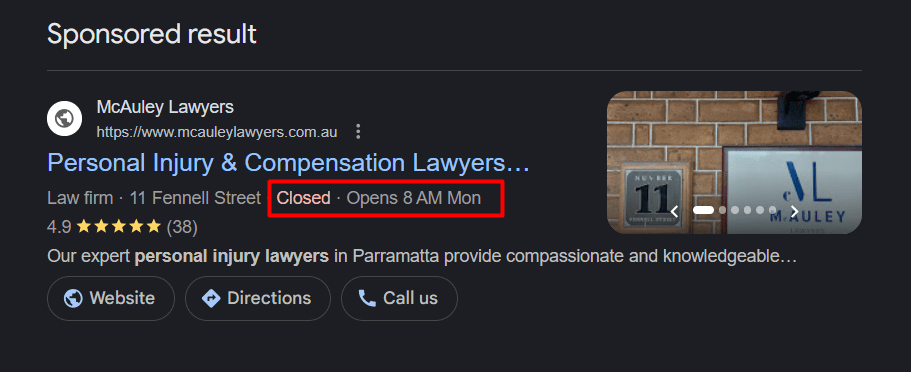
While critical for brick-and-mortar businesses, open hour extensions are notably underutilized in top-performing legal ads. This suggests that for many law firms, the priority is driving calls or form submissions regardless of hour, or that service is available 24/7 for critical matters. However, for firms with specific consultation hours, this extension manages expectations and improves lead quality.
Key takeaway: Use open hour extensions if your firm has strict office hours to filter for relevant clients. For others, focus on extensions that drive immediate action.
Google Search Ads CreativeUsage
| Element | Top Ad Trend | Recommendation |
| Headline | 40% use CTA + USP | Combine your key differentiator (“Free Case Review”) with a clear action (“Call Now”) in your most valuable real estate. |
| Landing Page URL | 100% are well-directed | Non-negotiable. The ad’s promise and the landing page must match perfectly to maintain Quality Score, trust, and conversions. |
| Description | 60% use USP + CTA | Use description lines to elaborate on benefits and reinforce the action. Create a persuasive narrative that addresses intent. |
| Keyword in Ad Copy | 50% contain search terms | Triggers bold text and signals high relevance to Google and users, directly improving CTR. |
| Headline Length | Mid-ranked ads have the most words | Brevity wins. Avoid overstuffing. Prioritize impact and clarity over comprehensiveness. |
| Description Length | Top-ranked ads use the fewest characters | Be concise and scannable. Use the minimum characters needed for a persuasive, benefit-driven message. |
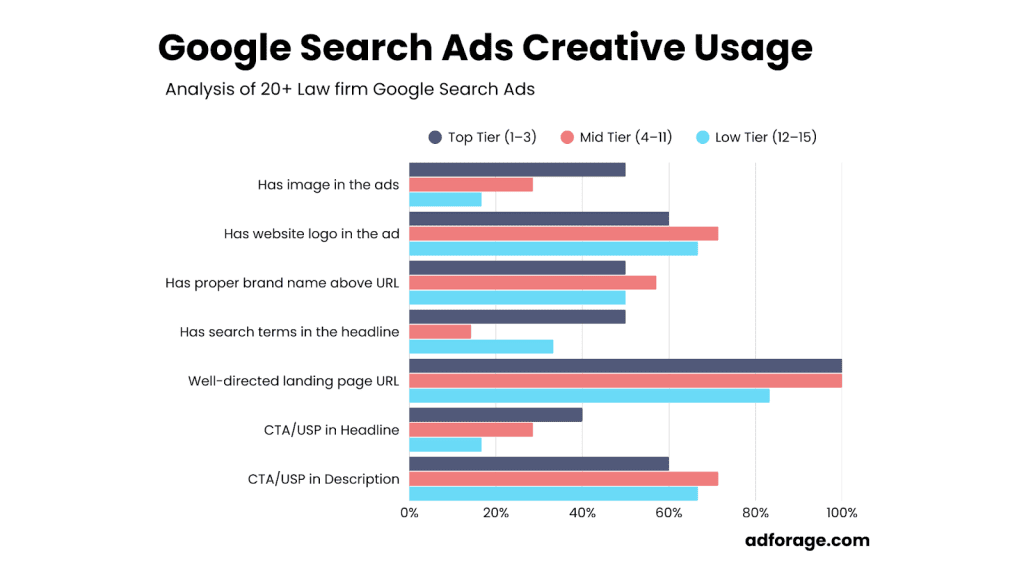
40% of top ranked ads use CTA and USP in their ads headline.
The headline is your most valuable real estate. Top performers don’t waste it. They combine a compelling Unique Selling Proposition (e.g., “Free Case Review,” “Voted #1 Injury Firm”) with a clear Call-to-Action (e.g., “Get Your Quote Today”). This 40% adoption rate among top ads proves that immediately communicating value and direction in the headline is a powerful driver of clicks.
Key takeaway: Your headline must do more than name your service. It should state your key differentiator and tell the searcher exactly what to do next.
100% of top and mid ranked ads have well directed landing page URLs.
Every single successful ad in our analysis sent users to a relevant, specific landing page. No top performer linked a generic “car accident” ad to their homepage. This universal practice underscores a fundamental rule: alignment between ad promise and landing page experience is non-negotiable for quality score, conversion rates, and ROI.
Key takeaway: Mismatched ads and landing pages destroy trust and waste ad spend. Ensure your URL leads directly to a page that fulfills the ad’s specific promise.
60% of top ranked ads have USP and CTA in their description.
Building on the headline, top ads reinforce their message in the description lines. A majority (60%) use this space to elaborate on their Unique Selling Proposition and repeat or strengthen their Call-to-Action. This creates a persuasive, benefit-driven narrative that addresses searcher intent and leaves little doubt about the next step.
Key takeaway:Use both description lines strategically. Expand on your USP’s benefits and end with a clear, action-oriented instruction to maximize conversion potential.
Almost 50% of top ranked ads contained search terms in their ads copy.
Relevance is king. Nearly half of the top ads directly incorporated the searched keywords into their ad text. This practice triggers bolded text in the ad, visually grabbing attention, and strongly signals to Google and the user that your ad is precisely relevant to their query. This is a direct contributor to improved click-through rates.
Key takeaway: Use keyword insertion or manually tailor ad copy to match high-volume search terms. Bolded text captures eyes and improves perceived relevance.
Mid ranked ads contain the most headline word count.
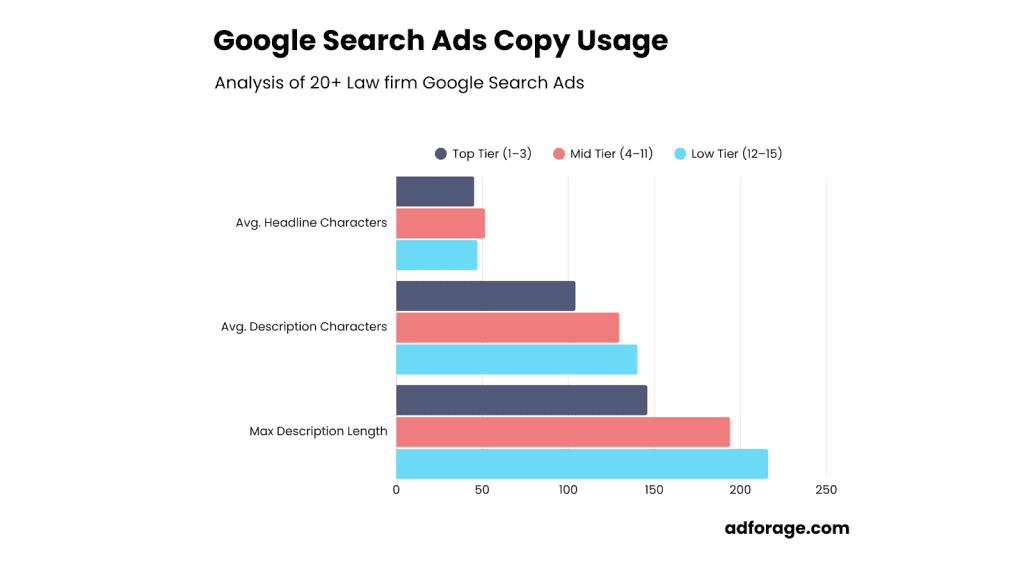
An interesting insight: mid-ranked ads often pack more words into their headlines. While top ads are concise and punchy, mid-tier ads may be trying to communicate too much at once or failing to prioritize the most impactful message. This suggests that overstuffing a headline can be a hindrance, not a help.
Key takeaway: Brevity and impact win over comprehensiveness in headlines. Be clear and value-driven, not verbose.
Top ranked ads copy contain the least number of characters in their ad description.
Echoing the headline finding, the most successful ads are masters of concise persuasion. They use the minimum characters necessary to communicate their USP and CTA effectively. This indicates a focus on scannable, benefit-driven language that works within the quick browsing behavior of search users, as opposed to lengthy, feature-heavy descriptions.
Key takeaway: Get to the point. Trim unnecessary words from your descriptions. Every character should serve the goal of prompting a click.
Conclusion:
Winning the ad rank battle comes down to strategic simplicity: use key extensions to stand out, craft clear and benefit-driven ad copy, and ensure your landing page perfectly matches your ad’s promise. By focusing on these user-centric principles, you’ll boost your click-through rate, improve your Quality Score, and lower your customer acquisition cost—making every ad dollar work harder for your law firm.
Frequently Asked Questions (FAQ)
Q1: What’s the quickest way to improve my ad rank?**
A: The fastest wins often come from fixing mismatches. Immediately ensure your landing page URL is hyper-relevant to your ad’s headline and keywords. Then, add at least two high-impact extensions—Sitelinks and a Call extension—to increase visibility and conversion options.
Q2: Should I use all ad extensions Google offers?
A: No. Use extensions strategically. Sitelinks and Call extensions are most critical for law firms. Image extensions are a powerful differentiator. Only use Open hour extensions if you need to filter calls outside business hours; otherwise, they may limit valuable leads.
Q3: My headlines are detailed. Should I shorten them?
A: Likely yes. The data shows top ads prioritize punchy clarity over comprehensive detail. Combine your Unique Selling Proposition (USP) and a Call-to-Action (CTA)concisely. For example, “Free Case Review | Get Your Compensation Now” is more effective than a long, descriptive sentence.
Q4: Do I need to redesign my landing pages?
A: Not necessarily redesign, but you must ensure direct relevance. A “car accident lawyer” ad must go to a dedicated page about car accident services, not your generic homepage. The page should deliver exactly what your ad promises, with a clear path to contact.
Q5: How important are keywords in the ad description?
A:Very. Including the search term triggers bold text, grabbing attention. More importantly, it signals high relevance to Google, boosting your Quality Score. Structure your ad groups tightly so you can naturally incorporate keywords into your descriptions.
Q6: Why are Image Extensions important for a professional service?
A: They break through the text clutter. A trustworthy attorney photo or firm logo builds immediate recognition and credibility in the split-second a user scans results. This visual cue can significantly increase your click-through rate.
Q7: If my ad is already converting, should I still optimize for rank?
A: Yes. A higher rank at a lower Cost-Per-Click (CPC) directly increases your Return on Ad Spend (ROAS). You can either get the same conversions for less money or use the savings to bid on more keywords and acquire more clients within your budget.
Q8: What’s the biggest mistake hurting ad rank for law firms?
A: The most common mistake is a disconnect between the ad and the landing page.. This destroys user trust and results in a poor Quality Score, forcing you to pay more per click. The second biggest mistake is using generic, feature-focused ad copy instead of a clear, client-benefit-oriented USP and CTA.
